
Under-25 claimants in Bracknell Forest rose 41% in two years, the steepest of 19 South East authorities, while the borough's overall rate stayed at 2.7%.
The number of under-25s in Bracknell Forest claiming benefits while looking for work has risen by 40.7 per cent in two years, the steepest increase of any of the 19 county and unitary authorities in the South East.
There were 415 claimants aged 16 to 24 in the borough in July 2026, against 360 in July 2025 and 295 in July 2024. That is a rise of 120 people in two years. (ONS claimant count via nomis, dataset NM_162_1, released 18 August 2026)
The borough’s headline figure gives no hint of it. Bracknell Forest had 2,315 claimants of all ages in July, 2.7 per cent of residents aged 16 to 64, the same rate as a year earlier and well below the South East’s 3.1 per cent and the UK’s 3.9 per cent. On the top line, very little has changed.
One age group is going one way
Split the total by age and the borough’s flat headline comes apart. Between July 2024 and July 2026:
- aged 16 to 24: up from 295 to 415, a rise of 40.7 per cent
- aged 25 to 49: up from 1,235 to 1,310, a rise of 6.1 per cent, and down 4.4 per cent in the last year alone
- aged 50 and over: up from 510 to 590, a rise of 15.7 per cent
The middle group is the largest, and it has been falling for a year. That is what holds the total still while the youngest group climbs.
Under-25s now account for 17.9 per cent of all claimants in the borough, up from 14.5 per cent two years ago. Almost all of them are aged 18 to 24: the 16-to-24 and 18-to-24 counts are both 415, so the 16 and 17 year olds in the figure round to nothing.
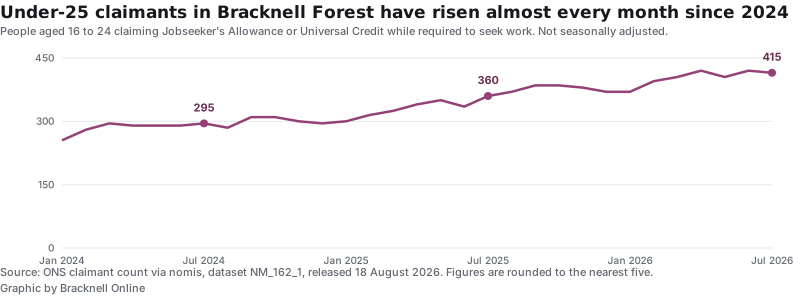
This is not one odd month. The count has risen in most months since the start of 2024, from 255 in January that year to 415 last month. July 2026 is the highest July figure the borough has recorded since 2021, when the count was still falling back from the pandemic. In July 2018 it was 85.
Steeper here than anywhere else in the region
Bracknell Forest’s two-year rise is the largest of the 19 upper-tier authorities in the South East, and it is close to double the regional figure.
| Area | July 2024 | July 2026 | Change |
|---|---|---|---|
| Bracknell Forest | 295 | 415 | +40.7% |
| Buckinghamshire | 1,240 | 1,710 | +37.9% |
| Surrey | 2,400 | 3,270 | +36.2% |
| West Sussex | 2,285 | 3,080 | +34.8% |
| Windsor and Maidenhead | 265 | 355 | +34.0% |
| West Berkshire | 340 | 440 | +29.4% |
| Slough | 730 | 940 | +28.8% |
| Wokingham | 325 | 410 | +26.2% |
| Reading | 820 | 885 | +7.9% |
| Oxfordshire | 1,560 | 1,625 | +4.2% |
| South East | 28,695 | 34,885 | +21.6% |
| United Kingdom | 287,350 | 332,335 | +15.7% |
The table shows the five steepest risers, Bracknell Forest’s Berkshire neighbours, and the two lowest of the 19. Oxfordshire, an hour up the road, saw its under-25 count rise by 4.2 per cent over the same two years.
Reading is the sharpest local contrast. It has more than twice as many under-25 claimants as Bracknell Forest in absolute terms, 885 against 415, but its two-year rise was 7.9 per cent against Bracknell Forest’s 40.7 per cent.
What the figures do not say
Three things are worth holding on to before reading too much into the percentage.
- The base is small. A rise of 120 people produces a large percentage in a borough this size. Areas with bigger counts move more slowly in percentage terms, which is part of why Surrey and Buckinghamshire sit near the top of the table and Kent and Hampshire do not.
- This is not the unemployment rate. The claimant count is the number of people claiming Jobseeker’s Allowance plus those on Universal Credit who are required to seek work and be available for work. It includes some people who are working but on low earnings.
- The figures are not seasonally adjusted, and ONS rounds them to the nearest five. July always carries school and college leavers, which is why every comparison here is July against July.
We have also not compared these numbers with the national headline in the ONS labour market bulletin. The nomis series that carries local authority figures gives a different UK total and moves in a different direction, so putting the two side by side would be misleading.
The borough lost its careers charity in 2024
One piece of local context belongs here, with a clear warning attached. Adviza Partnership, the Bracknell based careers and youth support charity that traced its roots back to Connexions, went into administration on 25 September 2024. It ran careers and employment advice for young people across Berkshire and Buckinghamshire, and reported income of £4.23 million in its last published accounts. We covered the deadline for its creditors earlier this month.
The borough’s under-25 claimant count has climbed through the period since. We cannot say the two are connected, and nothing in the published figures links them. Careers advice is one influence among many on whether a 19 year old finds work, and the same two-year rise shows up, less steeply, across the whole region.
What it means for you
If you are 18 to 24, on Universal Credit and living in Bracknell Forest, the
council runs a free Youth Employment Hub for exactly that group. It is based
at the Open Learning Centre and describes itself as support for young people
“looking for work, training or direction”. You can email
yeh@bracknell-forest.gov.uk directly, or ask your work coach, school, college
or support worker for a referral. (Bracknell Forest Council, Youth Employment
Hub)
If you are 16 to 18, or up to 25 as a care leaver or with an education, health
and care plan, the council’s Elevate team gives careers guidance, and
works with young people who are not in education, employment or training. It is
on 01344 352777 and elevate@bracknell-forest.gov.uk. (Bracknell Forest
Council, Elevate team)
If you are an employer in the borough, the hub says it works with local employers, training providers, colleges and Jobcentre Plus. The same email reaches it.
If you want to check the figures yourself, they are free to download. nomis publishes the claimant count by local authority, age and month, and updates it on the same day as the ONS labour market release. The next one is due in September.
Related
- Bracknell house prices: what the borough’s average has done over the same period.
- Bracknell planning news.
- Businesses trading in Bracknell.
Sources
- ONS claimant count, via nomis dataset NM_162_1, released 18 August 2026, for every count and rate quoted: Bracknell Forest, the 19 South East county and unitary authorities, the South East region and the United Kingdom, by age, for July 2024, July 2025 and July 2026, and for the monthly series in the chart.
- nomis source notes on the claimant count for the definition quoted above.
- Bracknell Forest Council, Youth Employment Hub for the eligibility, location and contact details.
- Bracknell Forest Council, Elevate team for the age range and remit.
- The Gazette, notice 5180857 and Charity Commission, charity 1132201 for Adviza Partnership’s administration date and last reported income.
Have your say