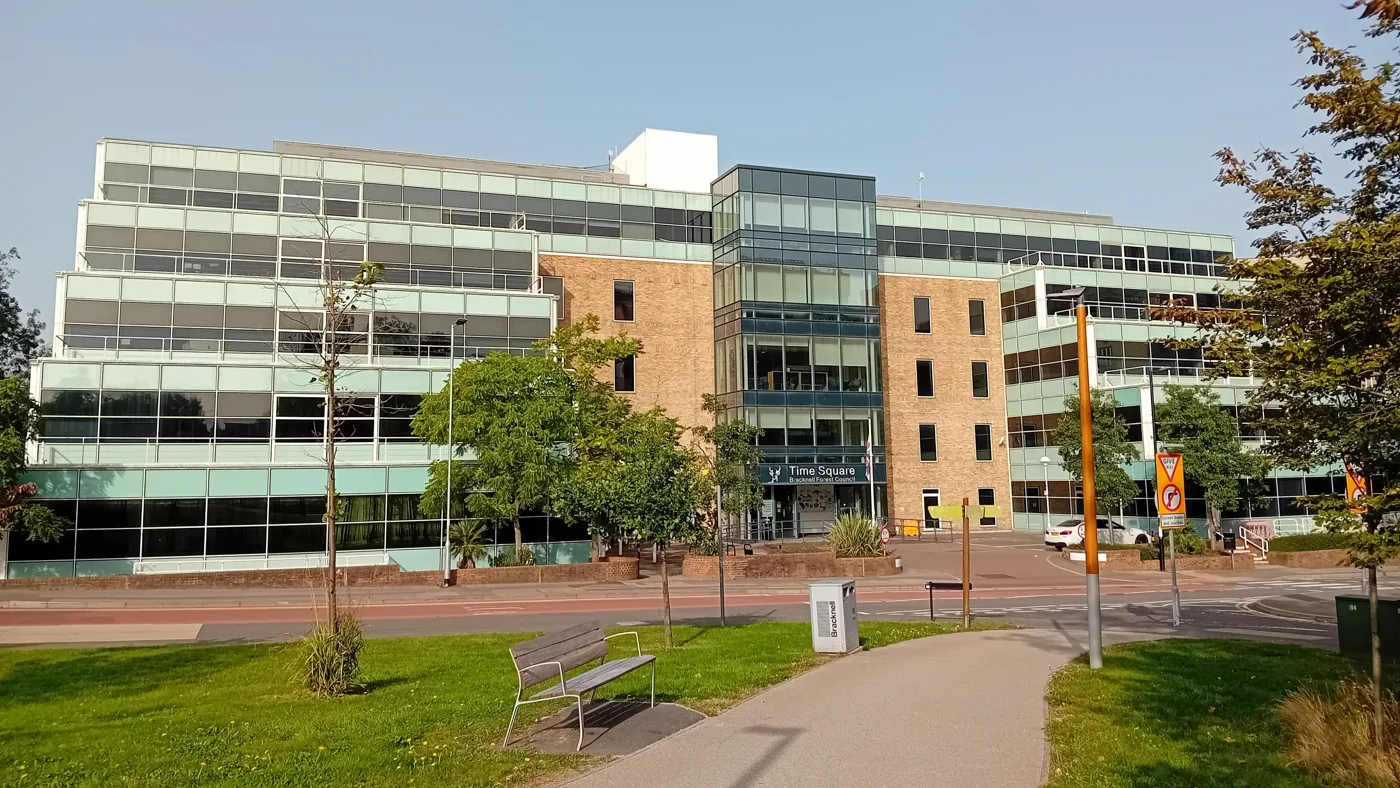

NHS data puts Bracknell Forest's diagnosis rate at 60.9%, down from 63.9% in March 2025. The council's survey on its next dementia strategy closes 18 September.
Bracknell Forest Council is asking residents to help write its next dementia strategy, and the NHS numbers behind that request are moving in the wrong direction. On 30 June this year, 846 people aged 65 and over in the borough were on a GP dementia register, against an estimated 1,389 living with the condition. (NHS England, Primary Care Dementia Data, June 2026)
That is a diagnosis rate of 60.9%. It places Bracknell Forest 214th of the 296 English lower-tier councils in the data, and below the England figure of 66.2%.
The difference between those two numbers is about 543 people. They are people the model expects to have dementia who do not appear on a GP register, which usually means they have not been diagnosed.
The register has not grown. The estimate has
The more useful way to read this is over time, and the monthly series makes the point plainly.
| Date | On the register | Estimated with dementia | Diagnosis rate |
|---|---|---|---|
| 31 March 2025 | 855 | 1,338 | 63.9% |
| 30 June 2025 | 838 | 1,346 | 62.3% |
| 30 September 2025 | 832 | 1,354 | 61.5% |
| 31 December 2025 | 835 | 1,362 | 61.3% |
| 31 March 2026 | 851 | 1,372 | 62.0% |
| 30 June 2026 | 846 | 1,389 | 60.9% |
Over those fifteen months the number of over-65s on a Bracknell Forest dementia register fell by nine. The estimate of how many have dementia rose by about 51. The rate fell three percentage points as a result.
Nothing here says fewer people are getting ill. The estimate is built from national prevalence rates applied to the local population, and Bracknell Forest’s older population is growing. What the figures do show is that diagnoses are not keeping pace with it.
How that compares in Berkshire
All six Berkshire unitary authorities are in the same dataset, so the comparison is like for like.
| Council | Diagnosis rate, 30 June 2026 |
|---|---|
| Windsor and Maidenhead | 66.9% |
| Reading | 66.0% |
| West Berkshire | 65.8% |
| Wokingham | 64.0% |
| Slough | 61.0% |
| Bracknell Forest | 60.9% |
Read that last pair carefully. Bracknell Forest and Slough are a tenth of a percentage point apart, which is not a meaningful difference. NHS England publishes a confidence range around each figure, and for Bracknell Forest in June it ran from 53.6% to 67.2%. The honest reading is that the borough sits in the lower group in Berkshire, not that it holds a precise position.
The national ambition, set in 2015, is for at least two thirds of people with dementia, 66.7%, to have a formal diagnosis. NHS England says a timely diagnosis “enables a person to access the advice, information, care, and support that can help them (and their carers) to live well with the condition”. (NHS England)
Bracknell Forest has been below that ambition at every month in the table above.
What it means for you
The council is writing an Integrated Dementia Strategy to cover 2027 to 2032, and the survey is open now.
- Closing date: Friday 18 September 2026.
- Who it wants to hear from: people with dementia, people waiting for an assessment or diagnosis, unpaid carers, family and friends, and professionals working with people living with dementia.
- How long it takes: about 15 to 20 minutes. Responses are anonymous and questions can be skipped.
- Paper copies: available by emailing BracknellCMHTOAAdmin@berkshire.nhs.uk.
- The five areas it covers: prevention, diagnosis, support after diagnosis, services for carers, and planning for the future.
The survey is on the council’s consultation site, and the council says the work is being done with its Dementia Lived Experience Group, health partners, care providers and voluntary sector organisations. (Bracknell Forest Council)
If you are worried about your own memory or someone else’s, the route to a diagnosis starts with a GP appointment. The figures on this page describe exactly that step: how many people have taken it, and how many the NHS thinks have not.
Sources
- NHS England, Primary Care Dementia Data, June 2026, published 30 July 2026. Borough and comparison figures are from the “Dementia Diagnosis Rate from 65+ by LA” file; the monthly series back to March 2025 is in the equivalent March 2026 file.
- NHS England: dementia programme and preparation for new Alzheimer’s disease modifying treatments, for the 66.7% national ambition.
- Bracknell Forest Council: help us shape the next Integrated Dementia Strategy
Have your say