
Government approval of Bracknell Forest's SEND plan unlocks a £29m grant that clears 90% of a £32.4m deficit. About £3.4m remains, plus this year's overspend.
The government has approved Bracknell Forest’s plan for special educational needs and disabilities (SEND). The council announced the approval on Thursday 15 October (Bracknell Forest Council).
The council’s press release does not mention money, but the approval is what releases it. A grant of about £29 million is paid only once a council’s plan has been approved, and it will clear most of the borough’s SEND debt.
The figures are in a report to the borough’s Schools Forum, which meets on 22 October (2025-26 Outturn on the Dedicated Schools Grant).
The deficit and the grant
Money for schools and SEND comes from the government’s Dedicated Schools Grant. For years Bracknell Forest has spent more of it on SEND support than it receives.
At 31 March 2026 the accumulated shortfall was £32,405,238, according to the Schools Forum report. A year earlier it was £24.3 million.
The government announced the High Needs Stability Grant in February 2026. It is meant to repay 90% of each council’s deficit. The report sets out Bracknell Forest’s calculation:
- £29,009,414 in grant
- £3,395,824 of deficit left over
The report says payment “has been tied to the development of the SEND Reform plan”. Allocations are paid only once a plan “is then approved as meeting the required criteria”. Bracknell Forest submitted its plan on 19 June 2026.
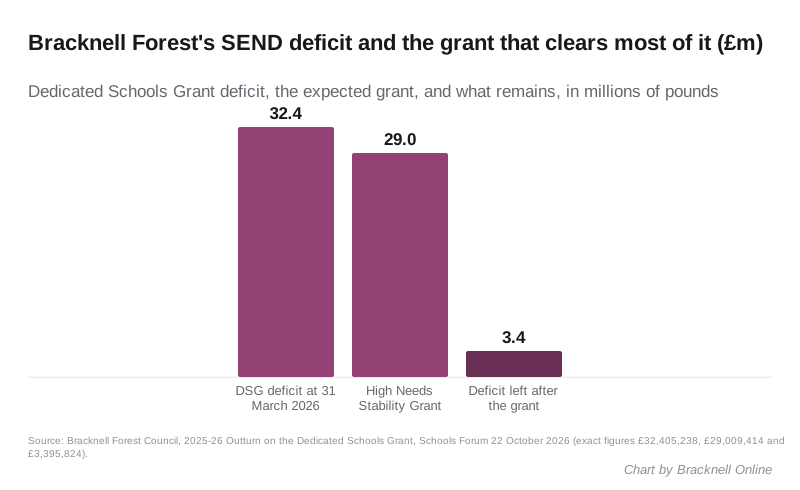
The grant is smaller than 90% of £32.4 million because of the council’s Safety Valve deal. In March 2024 the Department for Education agreed the council’s bid to join that programme, worth £16 million. The council received £9.14 million under it before the programme ended. The formula adds those payments and the council’s own contributions back, takes 90%, then deducts the payments again.
Where the money goes
The report shows how the overspend built up. In 2025-26 the whole schools grant overspent by £7.756 million. The high needs block, which pays for SEND, overspent by £11.330 million, partly offset by savings elsewhere.
The most expensive placements are a small share of children:
- about 10% of pupils with an education, health and care plan (EHCP) go to independent or non-maintained special schools
- those places take about 36% of the high needs budget
- the average place costs £67,650 a year
The report adds that when a tribunal decides such a school is right for a child, the borough “can often find itself facing higher than expected additional costs”.
Demand is rising fast. Bracknell Forest maintained 1,718 EHCPs in January 2026, against 775 in January 2019, according to the Department for Education’s EHC plans statistics.
The deficit is not gone
The finance officers’ own warning is in the same report. The grant brings the debt down to about £3.4 million, “but there is uncertainty about how any deficit that arises in 2026-27 and 2027-28 will be addressed”. That means “the authority still faces a significant risk”.
The council’s release says the government will keep watching. There will be quarterly reviews and “ongoing monitoring” to make sure improvements are “delivered at pace”.
Schools are being asked to help with the next gap. A separate Schools Forum paper proposes moving 0.5% of school budgets into SEND funding in 2027-28. The council says this “would support the SEND Reform Plan”. A consultation with schools opened on 5 October and closes on Friday 23 October. The Schools Forum decides on 12 November.
One thing that has improved
Bracknell Forest now issues new EHCPs on time. The legal deadline is 20 weeks. In 2025 the council met it for 129 of 130 new plans, or 99.2%, according to the DfE’s timeliness data.
That compares with:
| Year | New plans issued | Within 20 weeks |
|---|---|---|
| 2023 | 256 | 39.8% |
| 2024 | 206 | 45.1% |
| 2025 | 130 | 99.2% |
The England figure for 2025 was 45.5% and the South East’s 46.2%. Of 18 South East councils with published figures, only Windsor and Maidenhead did better.
The number of new plans also fell, from 206 to 130, so the council was handling fewer cases.
What it means for you
- If your child has an EHCP, nothing changes to their plan because of this approval. The grant pays off old debt rather than adding new support.
- If your child is waiting for an assessment, the 2025 data shows plans being issued within the 20-week legal limit in almost every case. The average was 14.3 weeks.
- If you work in a school, the 0.5% transfer consultation closes on 23 October. Your head teacher or governors will have the consultation.
- If you want to see the plan’s targets, the council’s release describes its aims but does not link to the plan itself.
The executive director for people, Grainne Siggins, said the approval was “an important milestone” and thanked parent carers, children and young people “whose experiences, insights and challenge have helped shape our priorities”.
Councillor Megan Wright, cabinet member for children, young people and health, said the approval showed the plan “has met the required threshold”.
The council’s plans for 173 new specialist places by September 2029 are in our report on the school places strategy, which Cabinet approved on 13 October.
Have your say